Showing posts with label learning outcomes. Show all posts

Sunday, November 10, 2013

Top Ten Graduate Teacher Mistakes: Number 8

This is a continuation of the top ten list I started a while ago. I'll get to number eight below, but first a quick review:

Top Ten Review So Far...

Number Nine was asking too many questions. As counter-intuitive as it may seem, sometimes asking too many questions (of your peers, of the course supervisor) hampers you when teaching. Of course, you need to ask questions. I get that. But, asking too many can give you too many options, which organizational theorist Karl Weick argues may hamper your decision-making and inhibit your ability to adapt on the fly.

Number Ten, seemingly contrary to number nine, was not having a lesson plan--thinking that you're going to go in there and wing it is a recipe for disaster. The obvious reason is things might not go well. You won't know what to say, and you won't have plan for what to do. Having a script of some kind, even if you deviate from it, is ideal.

But let's say things go great, better than you expected. You leave class on a high, get back to your office, and sit down. Then you wonder, what did I just do? Unless you write notes of the class interaction, how are you going to repeat what you did for your next class or next semester (not that you can necessarily replicate results, but that's a mistake in thinking I'll tackle later)? So, you write down the class interaction. Okay, never mind that you're retroactively writing a lesson plan, which you may have been trying to avoid in the first place; what did you intend to accomplish in class? The only reason this question is important is, how do you know you accomplished what you intended?

This leads us to number eight.

Number Eight: No Assessment

I know I've said it here before, but you need to be able to assess whether or not you accomplished your objectives for a particular class. When many people hear the word "assessment," they think about statistical measurement. That's not necessarily what I mean. Sure, you can use tests. But you can also use qualitative measures like classroom discussion and written responses.

With assessment, you can better tell whether you accomplished what you wanted to in class that day. This, of course, assumes you also have learning objectives or goals (see my previous posts for more on that).

With assessment, you can tell what you need to tweak for next time. You shouldn't chuck your entire lesson plan because your assessment tells you you didn't meet your learning objectives for that day. Give it a few times. Then re-assess.

Teaching is nothing if not self-reflexive. Assessments help us as teacher be reflexive about what we accomplish in class.

Saturday, September 17, 2011

Top COMM 103 Student Tweets (So Far) of Fall 2011 (NSFW)

Ironic that although some tweets aren't safe for work, I've read them and counted them as part of my work as a university professor teaching communication and media literacy to mostly first-year students.

Using Student Tweets to Illustrate Media Literacy Concepts
I've had a debate with some teacher friends on facebook as to whether I should take students to task for their tweets. I find it useful to use some examples of questionable tweets in class as a way of teaching media literacy. It helps me illustrate: 1) there's not such thing as "privacy" or "anonymity" on the web; 2) you need to mindful of multiple audiences with social media messages; and 3) you must be mindful of possible unintended messages when using social media.

Now, I never call out specific students, and I don't intend to put them "on blast," as the students like to say (and get no shortage of laughs hearing me say it in class). I should note that I make it clear on our  BlackBoard site as well as on the syllabus that there is a class Twitter account. In most cases I use publicly accessible tweets (i.e., tweets that aren't locked and only available for followers, and tweets that can be found through a simple term search on twitter). In other cases, I use the tweets of students who chose to follow our COMM 103 class, thereby giving me access to their tweets. I use their tweets in class lectures in an attempt to teach students to be more mindful of the messages they send out into the amorphous universe of electronic media.

Why Not? Blurring Classroom Boundaries for Better or Worse
So, what's the debate? Well, some friends say that I shouldn't hold students accountable for what they say on twitter because, although I have a twitter account for class and many students choose to follow me, it's not really classroom communication. I disagree. The classroom is wherever students and teachers interact. Now, that may be an unfairly broad definition which may prompt the questions, "So, if you see a student at Target should you expect them to act like a student (e.g., respectful, polite)? And in turn, should you be expected to answer their questions about class at said Target store?"

 These are good questions. And although social media has certainly blurred the boundaries of in-class and out-of-class, is it fair for me to (re)define those boundaries in a way convenient for me? I don't have an easy answer.

So, my response to tweets isn't necessarily one of chastising but usually silence (and somehow referencing it in class) or measured responses. Below are some examples.

Example One: Why do I need this class?
I talk in class about why, although some communication concepts may seem common sense, it's important to think about these concepts to be mindful of our communication habits and in which contexts those habits might or might not be appropriate.

Somehow, though, the concept of mindfulness didn't seem to resonate with this student:

These tweets are publicly accessible and easily found with a Twitter search of "communicate"
I didn't respond to these specific tweets, though I did to another one about one of our quizzes (I again found it through a search). Although this student didn't go back and delete these posts above (some do with their more "saucy" tweets), this student did respond to me. Hopefully, the interaction generated via Twitter will lodge itself in this student's thinking about media use.

Example Two: I don't need this class; in fact, I hate this class
The tweets below were decidedly more vitriolic:

These are publicly accessible with a simple search of COMM103
Here's how I responded:


I'm not sure if this student still checks this Twitter account. But my response is typical of how I handle such things. I find this approach usually does work with students who might initially seem like they hate the class but are, in actually, just worried, nervous, or otherwise concerned with their class performance. Which leads me to the next example:


Example Three: I sound like I hate this class, but I'm actually just a little overwhelmed
Sometimes, I think students spew some tweets that don't actually mean what they might sound like to a teacher. Case in point, the below exchange, which began with a measured response to an "I hate this class" tweet (like my example above):
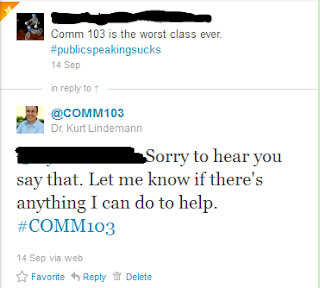
These are publicly accessible with a simple search of COMM103
Unlike the above example, though, this student responded to me. And not in the way I expected:

The bottom tweet is the first one in the series
So, I responded in kind:

And this exchange had a (sort of) happy ending. Perhaps the best a teacher could hope for in this asynchronous social media exchange.

Example Four: I actually like this class
There are many positive tweets as well. Below is one:

Obviously, the #COMM103 hashtag, which I encourage students to use, makes this publicly accessible tweet easy to find
To these I usually respond, "Glad you're enjoying it" or something like that, taking a chance that the tweet isn't ironic in its use of multiple exclamation points.

What's It All For? The Future of Social Media in My Classroom
My use of the class Twitter account is a work in progress. But I think its utility and possibly lie in more than just communicating class information to students or answering questions (out of class or, as some instructor now use it, in class with a moderated live feed). Its use, and teachers' framing of its use, is rooted in the concepts of media literacy. We must be vigilant in illustrating to students the ways intention, audience, and tone play complex roles in social media.

Update
I was recently honored for the kind of experiments I detail above. You can read more about this on the SDSU News page.

Thursday, August 11, 2011

Top Ten Graduate Teacher Mistakes: Number 9

This is a continuation of the "Top Ten" list I started several months ago. I realize now it was a pretty ambitious goal for me. I should have made it a Top Five list. At any rate, as promised, here's number nine:

Number Nine: Asking Too Many Questions
Some of my graduate student teachers may be reading this thinking, "Is he talking about me?" Well, yes, but not in a bad way. I'm talking about myself as well, I suppose. As I prep for my Fall classes, I'm faced with making assignments new again. And while I can plan things out, starting with learning outcomes and following through to some kind of assessment, there's no way I can really tell if something's going to work.

The more experience a teacher has, the better she can anticipate what questions and difficulties students might have. But she can never really know how a new lesson plan will turn out. Sometimes we have great stuff we think the students will love, and they don't. Other times, we might go in and wing it only to have things go great. When this happens I sometimes walk out of class thinking, "It's too bad I won't be able to replicate that dynamic every time, because that was great."

I encourage asking questions, and believe me, some graduate student teachers take this to heart and ask all sorts of things I honestly had never thought of before. While I can answer some--or most, I hope, some questions teachers have are better left unanswered. "Will this work?" I don't know. Maybe. Consider so-and-so and give it a try. "Is this activity a good idea?" Unless you're talking explicitly about sex or admonishing students about a particular religious point of view, you're probably safe. Give it a try. And so on.

The short answer: I don't know. The longer answer involves a communication theory, as most of my longer answers do: specifically, sense-making. Karl Weick, who forwarded said theory, is famous for a saying, which I'll paraphrase here: How do I know what I want to say until I see what I said? Setting aside for a moment the ableist language in that colloquialism (it privileges speaking and hearing as the primary knowledge-gaining senses), I like it and think it applies here. I realize this doesn't really hold water if we're accountable for students' test scores and such. But even within such constraints, in fact, some say only within constraints,  creativity and problem-solving coalesce in the art that is teaching.

Wednesday, May 4, 2011

Top Ten Graduate Student Teacher Mistakes: Number 10

As I wrap up another year of serving as Basic Course Director for our school, I'm reflecting on the progress of our graduate student teachers. They do some amazing things, make me look good, and--to my bemusement--attribute their teaching success to me when it sometimes appears to me if I've had little to do with how good they've become.

I think I only really, truly, began to get the hang of teaching in about my sixth year. I've been teaching college and university classes for about 18 years, and only now do I begin to feel like I might have some sort of advice to offer those just beginning to teach. Of course, I've been doing for this several years but have relied heavily on what others have said. Like any good scholar, I've begun to internalize those things, synthesize them, and take credit for them.

So, here is the first in a series of installments on some mistakes I've not witnessed graduate student teachers commit, and mistakes of which I myself am guilty (and how could I effectively teach them if I didn't first experience them?). I've resisted doing the typical scholarly thing and use parentheses, as in "Top Ten (Graduate Student) Teacher Mistakes." But hopefully you get the idea.

These are in no particular order, although I think the lower-stake mistakes are generally near the bottom.

Number Ten: No Lesson Plan
I used to think lesson plans were for elementary school teachers. College professors didn't need them, right? After all, they were teaching their specialty. They were afforded academic freedom, which meant talking about what they deemed relevant and appropriate. Students, basking in the glow of professors' knowledge, would write things down and ask questions, allowing the teacher to re-direct where necessary. Right?

Thankfully, I didn't actually put these ideas, accumulated from years of bad movies about college life, into practice. But I was shocked when I got into the college classroom and found it difficult to fill the hour or so talking about what I was already supposed to know. Teaching my first college class as a first-year M.A. student was terrifying, and I had done theatre and competitive speech and debate my whole life. I believe I spent the first 10 minutes or so reading from the book and hoping students would react to it. No lesson plan. I wasn't taught about lesson plans in my orientation, wasn't taught Bloom's taxonomy, learning objectives or outcomes, assessment...nothing.

So, one of the things I stress to my graduate student teachers is to create lesson plans. To not just think about what they want to say, but literally write out a lesson plan, beginning with learning outcomes and ending with assessment strategies (qualitative, e.g. discussions, and/or quantitative) that pair with a particular learning outcome. I ask them to also include the time each section might take and, if appropriate, the learning styles to which they might be appealing (I know some people have issues with the whole "learning styles" approach, but that's another subject for another post--for that matter, so is assessment).


I realize this sounds both simple and simplistic. But I'm always surprised, especially in the second semester onward, how many GTAs take the "been there, done that" approach and just go into class thinking, "I'm going to do this activity and it's going to be really cool." Okay, you've got the activity. So what? What's the purpose? How are you going to know whether the activity made any difference?

Now, I find myself doing this in my lectures: just going in and talking. Of course, I know what I want to say and what I have to cover, but I find myself glossing over learning outcomes as well.

As I write this, I can hear some of my colleagues advising teachers to stay flexible and not plan everything out, as some of the best teaching and learning moments emerge organically. And I agree. But I'm not sure beginning teachers can go there just yet. So, I advise creating lesson plans but maintain a flexible mind just in case.

One of the things I like about teaching is that I'm constantly learning. I'm learning as I write these, and as I present them to our graduate student teachers. And I encourage them not to take these as edicts, but as guidelines that will prompt a thoughtful and reflexive consideration of the classroom and of their teaching.

Next up, Number Nine: Asking Too Many Questions